
OEM/ODM Jewelry Manufacturing: Prototype, Sample, Batch
A custom order passes through three distinct artefacts, and confusing them is expensive. The prototype is a file delivered in 48 hours, 25–30 days, 3–4 weeks — CAD, sample, run — CAD, sample, run — CAD, sample, run — CAD, sample, run — CAD, sample, run in production once the sample is approved. Each gate answers a different question.
Key takeaways
- Gate one is a CAD file and renderings, published at under 48 hours, and it settles dimensions rather than look.
- Gate two is the master sample after 25–30 days, spanning wax printing, casting, stone setting, polishing and electroplating.
- Gate three is the batch at 3–4 weeks, quoted for one design and one specification.
- Only gate three ships through a published 100% inspection, so gates one and two carry the decisions.
Gate one: the prototype is a file before it is a piece
The first artefact in an OEM/ODM order is not a ring, it is a drawing. The 3D CAD stage is published at under 48 hours and delivers dimensional drawings plus realistic and virtual renderings, which are what a buyer signs off dimensions against.
Treat this gate as the specification gate. Material, plating route, chain and finding, stone sizes, hallmark placement and packaging all belong in this conversation, because every one of them changes either the drawing or the routing that follows it. Approving the render as a picture is the mistake; approving it as a set of instructions is the job.
Gate two: the sample is a commitment
Master physical sampling takes 25–30 days and is the factory's own first physical answer. The sequence inside it is fixed: 3D wax printing, precision mould casting, stone setting, polishing and custom electroplating.
Once the master exists, two things become real at the same time: the tooling and the plating. Tooling fixes the geometry, and plating fixes the finish stack, whether that is PVD plating on stainless work, rhodium, an anti-tarnish e-coat on silver and brass and multi-layer gold in 14K, 18K and 24K. From here, changes are rework rather than edits.
Gate three: the batch copies the sample
Bulk production is published at 3–4 weeks after sample approval, and its entire job is to reproduce the approved master at volume. That is why the batch is a different kind of decision from the sample: you are choosing a specification to repeat, not a piece to admire.
Because the batch is defined by what was approved, a missing detail at gate two is invisible now and expensive later. A pouch colour approved verbally, a barcode label nobody designed, or a hallmark placement agreed in a call will all surface here, at the point when pieces are already cast.
What each gate should answer in writing
Gate one answers: are the dimensions and the placement right, and is the specification complete? Gate two answers: does the drawing survive contact with metal, stone and plating? Gate three answers: does the finished run match the approved sample, piece after piece?
Write the answer down at each stage rather than accepting it in conversation. Under an OEM/ODM programme the design and its documents stay with the brand, and moulds and CAD files are not resold — which means the record of what was approved is yours to keep and the only protection against a second run drifting from the first.
When a batch fails because a gate was skipped
The failures that reach the end of a production run are almost never casting failures. They are undecided items: a stone size informally swapped, packaging art that never existed, a chain spec that was assumed to match a reference photo. Each one was a two-minute question at gate one and a batch-level problem at gate three.
The published controls exist for exactly this reason: a dedicated project manager to hold the decisions, a 24-hour response window to keep them moving, and 100% inspection before packing as the last net. Behind those controls sits a quality management system documented to ISO 9001:2015, which is what turns "we always do it this way" into a sequence an outside party can check. None of the controls replaces a written approval, but together they make one worth having.
Approval discipline across three gates
Keep one running document with three sections and add to it as the project moves. Every gate gets a date, a version and a named approver on your side. When the inspector picks up the finished pieces, that document is what they are checking against.
It also gives you a defensible position if a second order is quoted later. A batch reproducing a documented specification is a straightforward job; a batch reproducing a memory is not.
| Gate | Artefact | Published window | What you approve |
|---|---|---|---|
| One | CAD drawings and renderings | Under 48 hours | Dimensions, material, placement |
| Two | Master physical sample | 25–30 days | Look, finish and fit of the tooling |
| Three | Production batch | 3–4 weeks | The repeatable specification |
| Close | Packed and inspected cartons | After the batch | What leaves the building at 100% inspection |
Worked example: the cost of reopening gate two
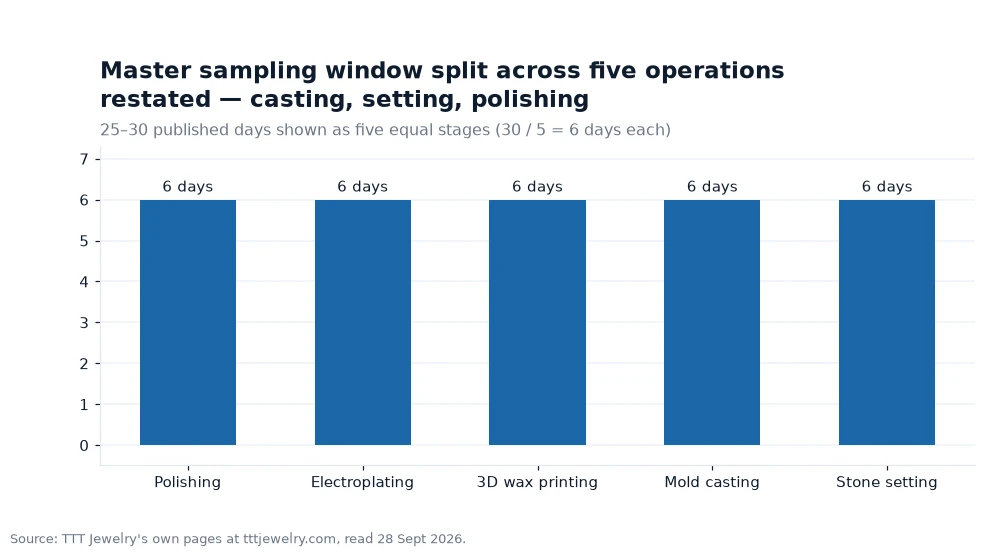
Sampling is published as a 25–30 day window containing five operations: 3D wax printing, mould casting, stone setting, polishing and electroplating. Divide it evenly and each operation holds 25 ÷ 5 = 5 days at the fast end and 30 ÷ 5 = 6 days at the slow end.
In hours that is 600 ÷ 5 = 120 hours to 720 ÷ 5 = 144 hours per operation. So a stone setting that has to be redone after the sample arrives does not cost an afternoon; it reopens a 120-to-144-hour slot, and every later operation queues behind it.
That is the arithmetic behind the standard advice to fix the drawing at gate one. The even split is mine; the 25–30 day window and the five named operations are the manufacturer's published figures.
Frequently asked questions
Is the prototype a physical piece?
The first artefact is a CAD file with dimensioned drawings and renderings, delivered in under 48 hours. The physical master arrives later, inside the 25–30 day sampling window.
What happens inside the 25–30 day sampling window?
Five operations run in sequence: 3D wax printing, precision mould casting, stone setting, polishing and custom electroplating.
Can a design change after the batch starts?
Only as rework. The mould and the plating route are fixed by the approved sample, which is why gate one and gate two carry the decisions.
Arriving at a quote with the gates already understood
Send the file, the finish and the quantity at once, and say which of the three gates you are at. A supplier can price a defined specification far more precisely than an idea, which is why the route is worth reading before you request a custom quote. If the design is likely to start in silver, the silver manufacturing page sets out how the 50-piece minimum works in practice, and the FAQ page answers the questions that come up before a first sample.
Everything factual here — the 50, 100 and 100+ piece order minimums with the master-sample benchmark and the 100% NDA terms — comes from tttjewelry.com, which I read on 28 Sept 2026. No figure above is estimated. The restatement in hours is my own construction[1].