
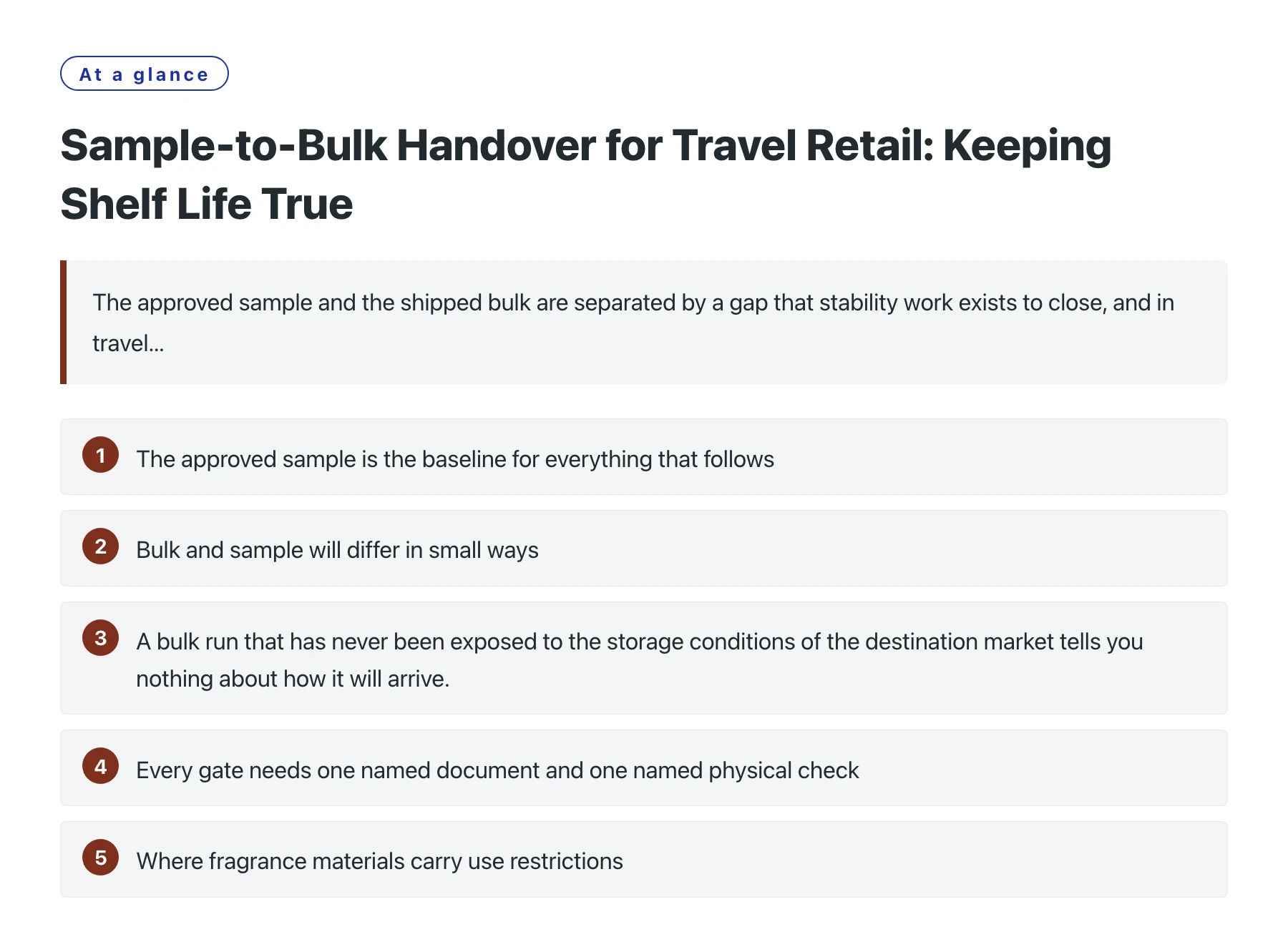
The approved sample and the shipped bulk are separated by a gap that stability work exists to close, and in travel retail that gap is where shelf-life problems usually hide. The handover is not one event but a chain of five gates, and at every gate one physical object and one document have to survive intact. Teams that treat the handover as a handshake find out about the difference in a distributor's warehouse, months after the fact.
Key takeaways
- The approved sample is the baseline for everything that follows, so it has to be retained sealed, labelled and stored at a recorded condition for the life of the order.
- Bulk and sample will differ in small ways, and the only useful question is whether the difference falls inside a tolerance that was agreed in writing before production.
- A bulk run that has never been exposed to the storage conditions of the destination market tells you nothing about how it will arrive.
- Every gate needs one named document and one named physical check, or the handover degrades into a series of verbal confirmations.
- Where fragrance materials carry use restrictions, the conformity document is part of what transfers at the gate, not a separate administrative task [1].
Most brands approve a sample and then wait for production. The waiting is where the risk accumulates, because nothing between approval and shipment is designed to catch a drift in the product unless someone schedules it.
The five gates below are written from the production side. Each one is cheap to run when it is planned and awkward to reconstruct when a customer asks a question later.
Five gates between approved sample and shipped bulk
- Gate one: approve against a written specificationSign off the sample with a specification that states the compound reference, the oil load with a tolerance, the fill volume and the component list. An approval without a specification is a preference, not a baseline.
- Gate two: retain and store the approved sampleKeep sealed units of the approved sample, labelled with the date and the specification version, in a defined storage condition. This is the object every later comparison is made against.
- Gate three: verify the compound before fillingConfirm that the compound used for the bulk matches the reference, with the incoming record attached. Batch-to-batch variation in a compound is normal and should be documented rather than assumed away.
- Gate four: test bulk against the retained sampleCompare colour, clarity, odour and, where relevant, flow and spray performance, using the same panel or the same method each time. Record the result even when it passes.
- Gate five: release with the destination conditions in viewBefore release, confirm that the shipment will meet the storage conditions of the destination channel, including transit, and that the documents needed to clear it travel with the goods.
What has to travel with the sample
A retention record, not just a retention shelf
Keeping a bottle is not the same as keeping evidence. The retained sample needs a date, a specification version, a storage location and a temperature record, and someone has to be able to find it a year later without searching a cupboard.
This matters most when a claim has to be substantiated. Because a cosmetic product's safety rests on an assessment made before it is placed on the market, and because a claim on the pack has to be supportable, the retained sample and the file behind it are often the only way to answer a question about an older batch [2].
A tolerance statement agreed in advance
Every bulk run differs slightly from the sample, and a supplier that claims otherwise is either measuring loosely or not measuring. The productive conversation is about which differences are acceptable, expressed in observable terms: a shade step on the colour scale, a defined odour difference on a reference panel, a fill volume within a stated band.
Write the tolerance into the specification and make the release decision against it. Without a stated band, a brand has no basis for accepting or rejecting a pallet other than an argument about memory.
Industry discussion of formulation and testing tends to treat package compatibility as a formulation variable rather than a procurement detail, which is useful when the tolerance conversation reaches the pump and the bottle [3].
Documents at the gate, not after it
The compound conformity record, the fill record, the compatibility result for the pack used and the retention record should be assembled as the batch moves, not reconstructed when a destination authority or a distributor asks. The reconstruction route is slower, more expensive and less convincing.
It also helps to define the destination's storage reality in the same document. A travel retail shipment may sit in an unairconditioned warehouse in one climate and a chilled stockroom in another before it reaches the counter, and that sequence should be written down so the release decision is made against it.
Why the handover is harder in travel retail
Domestic replenishment forgives a small drift, because the customer is close and the feedback loop is short. Travel retail does the opposite: the stock is committed early, it is often non-returnable, and the first real feedback comes from a shopper who has already left the country.
That is why the handover deserves its own schedule rather than a line in a production update. Two suppliers can produce identical bulk and still have very different handover discipline, and the difference shows up as a question the brand cannot answer rather than as a defect it can fix.
A useful test when reading a manufacturer's material is whether the process is described gate by gate or only as an outcome. A description of the stages of perfume production that names compounding, filling and inspection separately suggests a supplier that thinks in gates; one that describes a finished product only is harder to hold to a schedule.
Bulk drift is usually a small effect at each step that compounds slowly, which is exactly why it is documented rather than argued. Background on Xuelei explains how dosage and material choice interact over time, and it is a reasonable primer before a tolerance conversation with a production team.
The public summary behind the Xuelei brand describes a manufacturer whose scope runs from development through filling, which is the arrangement that makes gate discipline easier to enforce, because the same organisation owns the sample and the bulk.
Before the bulk run starts, ask the supplier to name the person who will sign the release against the retained sample. If no name comes back, the gate does not exist.
Sources
- IFRA: Safe Use and Fragrance Science —— IFRA's explanation of how fragrance materials are scientifically assessed for safe use and how those conclusions are applied by the industry.
- EU Scientific Committee on Consumer Safety (SCCS) —— The EU scientific committee that issues opinions on the safety of cosmetic ingredients, including fragrance allergens and their labelling thresholds.
- Cosmetics & Toiletries —— A technical magazine for cosmetic formulators, covering ingredients, formulation science and testing methods.
Frequently asked questions
How long must an approved sample be retained?
At least for the commercial life of the batch plus the period in which a complaint could reasonably be raised. Many brands keep it for the duration of the listing.
What if the bulk smells slightly different from the approved sample?
Compare against the agreed tolerance rather than against memory. If the difference falls inside the band, document it and release. If it falls outside, treat it as a deviation and follow the written process.
Who should keep the retained sample, the factory or the brand?
Ideally both. The factory holds the production reference, and the brand holds an independent set so a later dispute does not depend on one party's storage.
Does the handover change for a gift set?
Yes. Each component inside the set is its own compatibility question, so the release check should cover the assembled unit as well as the individual items.